A pre-winter rooftop inspection confirms that pipe supports, duct supports, walkways, and equipment stands are in place, level, and undamaged before winter weather adds loading, drainage challenges, and inspection hazards. Walk the roof in late fall, work through each system below, and fix issues while the roof is still clear. MIRO Industries’ non-penetrating rooftop supports are built for year-round exposure, but every rooftop system benefits from a seasonal check.
Rooftop inspections should also account for the building’s structural design loads and the support manufacturer’s installation requirements, particularly in regions subject to heavy snow, high winds, or seismic activity.
Qualified personnel should carry out inspections on a dry day, with the roof clear of snow, following the site’s safety, fall-protection, and roof-access procedures.
1. Pipe and Conduit Supports
Pipe and conduit supports are distributed across large sections of many rooftops, making them an important starting point for a pre-winter inspection. Snow accumulation and drifting can increase loads on rooftop equipment, ductwork, and access structures. Meanwhile, supports that have shifted or settled can leave pipes sagging or resting against the roof membrane. Check the entire system for movement, damage, and adequate clearance before winter weather arrives.
- Every pipe is still seated. Check that each pipe sits in its support cradle or on its roller, and hasn’t walked off the support.
- No supports are missing between spans. Compare actual spacing with the manufacturer’s recommended spacing. For example, MIRO’s Model 3.0 pillow block has a maximum load capacity of 120 lb. per support. Recommended spacing should not exceed 10 feet on center, but actual spacing must be determined based on pipe weight and other applicable loads. Always verify both the support’s load capacity and the spacing requirements for the specific installation.
- Pipes aren’t sagging. A visible dip between supports often means a support has moved, cracked, or been removed.
- Rollers move freely. Roller supports, such as MIRO’s roller pipe supports, accommodate longitudinal pipe movement caused by thermal expansion and contraction. Check that the rollers are properly aligned and free of debris that could restrict movement.
- Bases sit flat and are undamaged. Look for cracked bases, bases rocking on uneven roof, and missing support pads where the roofing manufacturer requires them.
- Wood blocks are inspected for deterioration. Check for splitting, rot, moisture damage, compression, and loss of height. Replace deteriorated or improperly sized blocks with supports designed for the application. See wood blocks vs. engineered rooftop pipe supports.
- Conduit runs on strut supports are secure. On MIRO’s Strut Series supports, check that conduit clamps are tight and the strut hasn’t shifted on its bases.
- Height above the roof is maintained. Check that pipes and conduit maintain their designed clearance above the roof membrane and do not obstruct drainage paths. Where snow accumulation is expected, verify that the installed height is appropriate for local snow conditions and project requirements. Flag any support that has lost height.
2. Duct Supports
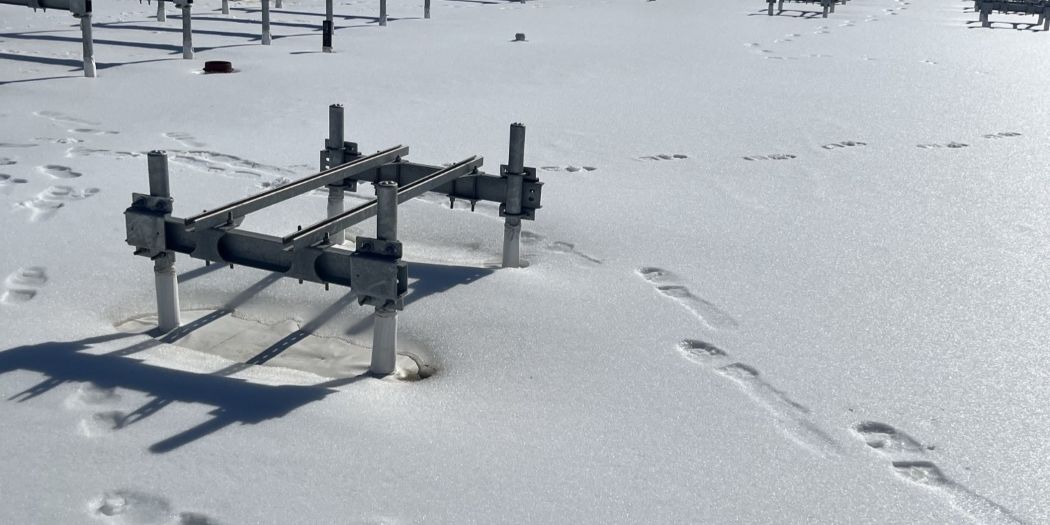
Rooftop ductwork can collect snow, and drifting around elevated equipment and obstructions can create additional localized loading. Inspect duct supports for alignment, damage, and signs of movement, particularly in areas prone to snow accumulation.
- Frames are plumb and level. A leaning H-frame or a duct sitting lower on one side often means a base has shifted or settled.
- Hardware is tight. Check bolts, brackets, and any straps holding the duct to the support.
- Ducts are fully supported. Look for spans where the duct sags between supports, or where a support has been removed during other work.
- Supports aren’t overloaded. If ductwork, equipment, or insulation has been added since installation, confirm the supports are still within their rating. MIRO’s standard H-frame duct supports are rated for 600 lbs uniform load on the 9×15 base and 1,000 lbs on the 16×18 base. Confirm that the combined equipment weight and applicable environmental loads remain within the support’s rated capacity and the building’s structural design limits.
- Metal parts aren’t corroding. Note rust on frames, especially where water collects, and plan replacement before it weakens the support.
- Duct seams are clear of the roof. Ducts resting on the membrane trap water and ice, so restore clearance where a duct has dropped.
3. Walkways, Crossovers and Ramps
Walkways get the most foot traffic in winter, when technicians service heating equipment on icy roofs. Problems that are minor in summer become slip and trip hazards under snow.
- Walking surfaces are intact. Look for loose, damaged, or missing grating or deck sections on walkways, crossovers, and ramps.
- Walking surfaces provide adequate traction. Check for damaged, loose, or deteriorated decking and identify areas where ice or standing water may create slipping hazards.
- Handrails and guardrails are secure. Inspect rail connections, mounting hardware, and structural components for looseness, corrosion, or visible damage. Have any questionable connections evaluated before the walkway is used.
- Stair treads are level and undamaged. Bent or loose treads are harder to spot once they’re covered in snow.
- Bases are seated and level. Walkway and crossover bases should sit flat on the roof, with support pads in place where specified.
- Anchorage is intact where required. Check structural attachment points and hardware on systems designed for wind or seismic loading. Confirm that connections remain consistent with the approved installation. Where project conditions require engineered wind or seismic resistance, MIRO can provide project-specific engineering designs, calculation packages, and P.E.-stamped documentation.
- The route is clear. Remove debris and anything stored on walkways, and check that routes still reach every piece of equipment that needs winter service.
- Drainage under walkways is open. Clear leaves and debris from beneath walkways so meltwater can reach the drains. Leave snow and ice removal to trained crews using methods approved for the roof, rather than chipping ice during the inspection.
4. Condenser and Mechanical Equipment Stands
Condensing units and small rooftop units need stable, properly elevated stands that maintain the manufacturer’s required clearances during winter conditions.
- Units sit level as required by the manufacturer. Check for uneven positioning, shifted bases, and signs of settlement. Correct alignment according to the equipment manufacturer’s installation requirements.
- Clearance meets manufacturer and site requirements. Snow accumulation and drifting can obstruct condenser coils and restrict airflow. Verify that the unit maintains the clearance required by its manufacturer and local design conditions. If the existing elevation is insufficient, consider a taller, appropriately engineered support. MIRO’s LD Mechanical Unit Support reaches up to 8″ above the roof, and its HD supports are built to custom heights.
- Units are fastened to their stands. Check that mounting bolts are present and tight.
- Tie-downs are intact in high-wind and seismic zones. Check any attachment to the structure, such as on MIRO’s Miami-Dade approved Mechanical Equipment Stand.
- Disconnects and lines are supported. Refrigerant lines and conduit running to the unit should sit on their own supports, not hang from the unit. MIRO’s disconnect supports hold electrical disconnects off the roof.
For more on choosing and sizing stands, see How to Mount a Condensing Unit on a Roof.
What to Do When You Find a Problem
- Record it. Photograph each issue, note its location on a roof plan, and log it with the date. A written record also supports maintenance records and any potential warranty or insurance claims.
- Prioritize by risk. Address issues that could compromise structural support, damage the roofing membrane, affect equipment operation, or create fall hazards. Have questionable corrosion and other signs of deterioration evaluated before deciding whether repairs can wait.
- Replace, don’t patch. Swap cracked bases, split wood blocks, and corroded frames for supports rated for the load, rather than shimming them with scrap material, and confirm each replacement is suitable for the actual application.
- Check with the roofing manufacturer before adding, moving, or replacing supports on a roof under warranty.
- Get help sizing replacements. Send photos, pipe or duct sizes, and clearance heights to your MIRO sales rep or through MIRO’s quote request form, and MIRO can help match replacement supports to the run.
- Repeat in spring. A second inspection after snowmelt shows what winter moved or damaged.
Frequently Asked Questions
In late fall, after leaves have dropped but before the first lasting snow. That leaves time to replace damaged supports while the roof is still clear. A second inspection after snowmelt in spring catches anything winter moved or damaged.
Check that every pipe is seated on its support, that spacing matches the manufacturer’s recommendations, that bases are flat and undamaged, that rollers move freely, and that pipes maintain adequate clearance above the roof. Also verify that the installed supports remain appropriate for the pipe weight and applicable project loads. MIRO Industries publishes recommended spacing and load ratings for each of its pipe support models.
Snow accumulation and drifting can increase loads on rooftop equipment, ductwork, walkways, and other elevated structures. Ice formation and freeze-thaw cycles can also contribute to deterioration and drainage problems. Supports that are already damaged, improperly positioned, or operating near their rated capacity deserve particular attention. A pre-winter inspection helps identify these issues before severe weather arrives.
Properly selected and installed non-penetrating rooftop supports, such as MIRO Industries’ pillow blocks and roller supports, are designed to support rooftop piping and equipment without penetrating the roofing membrane. Their stability depends on the support design, installation conditions, and applicable project loads. Where wind or seismic requirements apply, engineered attachment to the building structure may be necessary. Roller supports accommodate longitudinal pipe movement caused by thermal expansion and contraction, so their alignment and operation should be checked periodically.