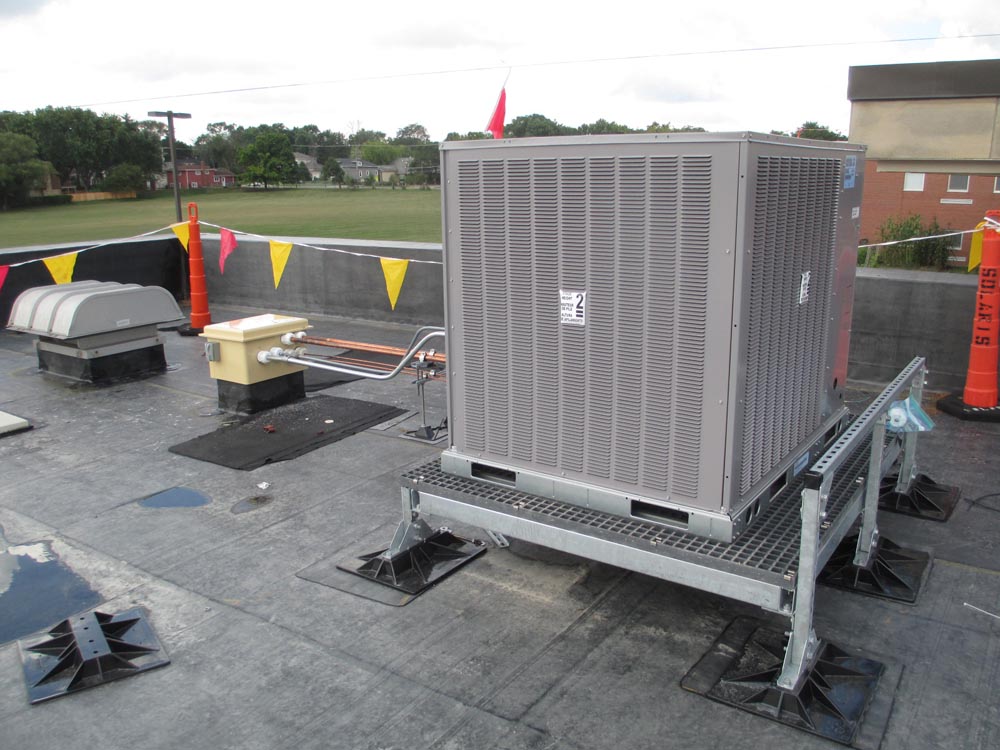
A rooftop condenser stand is a support frame that raises a condensing unit above the roof surface. This helps maintain drainage and service access while helping protect the roof membrane. For many commercial and light-commercial rooftop applications, a non-penetrating mechanical support is a practical way to elevate a condensing unit while avoiding unnecessary roof penetrations. Size the stand to the unit’s weight and footprint and to the manufacturer’s clearance requirements. MIRO Industries’ mechanical unit supports are backed by a 20-year warranty.
This guide covers why condensers shouldn’t sit directly on the roof, how stands compare with curbs and platforms, how to size a stand, and what changes in high-wind and seismic zones.
Why a Condensing Unit Shouldn’t Sit Directly on the Roof
Setting a condenser straight on the membrane, or on improvised supports, can cause problems that show up months later:
- Drainage. A unit set directly on the roof can interfere with drainage around it. Standing water can contribute to membrane wear over time.
- Membrane wear. Vibration and movement can wear or damage the membrane if the support or base is poorly chosen or installed.
- Service access and clearances. Raising the unit gives technicians room to reach panels and lines. Airflow and clearance requirements vary by unit, so follow the manufacturer’s installation instructions.
- Roof warranty considerations. Penetrations and incompatible base materials can raise warranty questions. Non-penetrating supports reduce the risks that come with penetrations, but they don’t automatically preserve a warranty. Confirm compatibility with the roofing manufacturer. See our post on how rooftop supports affect your roof warranty.
A properly sized condenser stand with roof-compatible bases addresses these issues. It spreads the load, provides a stable mounting surface, and elevates the unit above the roof.
Condenser Stand vs. Equipment Curb vs. Platform
For many split-system condensers and small rooftop units, a non-penetrating stand is a straightforward option. Curbs and platforms fit different situations.
| Option | How it attaches | Best for | Trade-offs |
|---|---|---|---|
| Non-penetrating condenser stand | Rests on bases on top of the membrane | Condensing units, mini-splits, small RTUs | Needs wind and seismic review in high-risk zones |
| Equipment curb | Built into the roof, flashed into the membrane | Large RTUs with ductwork through the roof deck | Requires a roof penetration and roofer coordination |
| Equipment platform | Larger frame or grating carrying several units | Groups of units, or units that need a service area | More material and cost than a single stand |
If the unit doesn’t need ductwork through the deck, a stand can avoid the need for a roof penetration and the associated roofing coordination. For units that need a work area around them, see our guide to rooftop service platforms for HVAC access.
How to Size a Rooftop Condenser Stand
Start with the unit’s operating weight, mounting footprint, and manufacturer-required clearances. These factors help determine whether an LD or HD support is appropriate.
| LD Mechanical Unit Support | HD Mechanical Unit Support | |
|---|---|---|
| Typical units | Small condensers, mini-splits, lightweight HVAC and ventilation units | Larger condensers, RTUs, refrigeration equipment |
| Load | 200 lbs max per support (check against the unit’s operating weight) | Engineered to the project’s required weight |
| Height | Up to 8″ above the roof | Custom height |
| Sizes | 24″×24″, 30″×30″, 20″×36″, 36″×36″, or custom | Custom, with rail-only or decked versions |
| Bases | Polycarbonate | Polycarbonate |
A few sizing rules of thumb:
- Match the frame to the unit’s mounting points, not just its overall footprint, so the unit can be fastened to the stand.
- Set height from project conditions. Required clearance comes from the unit manufacturer and from site conditions such as drainage and expected snow depth. If you need more than 8″, consider an HD or custom-height support.
- Provide a level mounting surface. Use adjustable supports where needed to provide a level installation in accordance with the equipment manufacturer’s instructions.
- Confirm that base loading is compatible with the roof assembly, insulation compressive strength, and structural design.
For a deeper comparison, read How to Choose the Right Rooftop Mechanical Unit Support: LD vs. HD.
Condenser Stands for High-Wind and Seismic Zones
In hurricane and seismic regions, a condenser stand has to keep the unit in place, not just hold it up. Depending on local code and project requirements, the unit may need to be fastened to the stand, and the stand attached to the structure or engineered for design loads.
MIRO’s Mechanical Equipment Stand is designed for high-wind applications and can be configured for project-specific requirements:
- Miami-Dade approved
- Adjustable from 2.5″ to 8″ to level the unit.
- Stainless steel, hot-dip galvanized or pre-galvanized metal parts for corrosion resistance in coastal climates.
- Bases that can be attached to the structure to provide resistance to wind and seismic design loads. See the NOA and spec sheets for approved attachment details.
- Designed for current decking and common roofing membranes. Confirm compatibility with your roofing manufacturer.
For larger units or site-specific loads, MIRO’s engineering team can design a custom wind and seismic solution. See MIRO wind and seismic supports.
Wind, seismic, structural and roof-compatibility requirements are project-specific. Confirm them with the engineer of record, local code officials and the roofing manufacturer.
Common Condenser Stand Installation Mistakes
- Using improvised supports. Wood sleepers and loose blocks may not provide adequate load distribution, membrane compatibility, long-term durability, or manufacturer acceptance. Use engineered supports with roof-compatible bases.
- Undersizing the stand. A stand rated below the unit’s operating weight can deflect or compress the insulation underneath.
- Skipping slip sheets or protection pads where the roofing manufacturer requires them under the bases.
- Too little clearance. Units set too low can trap snow and debris and leave little room for service.
- Failing to support the lines and disconnect. Refrigerant lines and electrical conduit to the unit need their own supports. MIRO offers pipe supports and disconnect supports to finish the installation.
- Not checking local wind and seismic requirements before ordering. Tie-down requirements depend on the project and local code. Address them during design rather than adding them after installation.
Get the Right Condenser Stand for Your Project
MIRO Industries has made non-penetrating rooftop supports in the U.S.A. since 1982. Browse our rooftop condenser stands and mechanical unit supports, or request a quote with your unit’s cut sheet and we’ll recommend the right stand.