| Rooftop pipe supports can affect a commercial roof warranty through three primary risks: membrane penetrations, incompatible base materials, and excessive point loads. Non-penetrating supports with compatible bases and proper load distribution reduce all three risks. But no support selection replaces confirming base compatibility with the roofing manufacturer before installation. MIRO Industries engineers non-penetrating rooftop supports designed to help protect the membrane and facilitate compliance with roofing manufacturer installation requirements. |
The phrase “may void your rooftop warranty” appears often in rooftop installation specs and guides. It reflects a real concern. Commercial roofing warranties are legally binding documents with specific exclusions. Improper support installation can trigger those exclusions.
The risk is manageable, but support selection should account for the roof assembly, warranty requirements, loading, movement, drainage, and installation conditions.
How Commercial Roofing Warranties Work
Material warranties and system warranties
Commercial roofing warranties and guarantees come in several forms. Two common categories are membrane/material warranties and system warranties or guarantees.
Material warranties generally cover the membrane or roofing material against specified manufacturing defects. Their coverage periods vary by manufacturer and product. They typically don’t cover damage caused by what is placed on or attached to the roof.
System warranties and guarantees cover the roofing system rather than only individual membrane materials. Some system guarantees are No-Dollar-Limit (NDL) guarantees, meaning the manufacturer’s obligation for covered repairs or replacements is not subject to a predetermined dollar cap, although coverage remains subject to the terms, conditions, and limitations of the guarantee. Depending on the warranty or guarantee, covered components may include the membrane, insulation, adhesives, fasteners, and specified accessories. Coverage periods vary by manufacturer, roofing system, contractor certification, and warranty or guarantee level. Roofing manufacturers issue these warranties and guarantees. Many manufacturer-backed system warranties and guarantees require installation by an approved or certified contractor and compliance with specified installation procedures.
Roofing manufacturers build explicit exclusions into system warranties. The most relevant for rooftop support installation:
- Unapproved penetrations: any penetration not made by an authorized contractor using approved methods
- Incompatible base materials: materials that attack or abrade the membrane surface
- Excessive point loads: loads that compress insulation and deform the membrane
- Failure to perform or document required maintenance: coverage may be affected when the warranty or guarantee makes inspections or maintenance a condition of coverage
The Three Ways Supports Affect Warranty Coverage
1. Penetrations
Where the warranty requires manufacturer-approved roofing work, each penetration should be flashed and sealed using the roofing manufacturer’s approved methods and materials by a contractor authorized under the applicable warranty terms.
Unapproved penetrations may jeopardize coverage for resulting leaks or damage in the affected area. In some warranty documents, unapproved penetrations that compromise waterproofing integrity can lead to broader exclusions or denial of related claims. The actual warranty language and the facts of the situation control.
Non-penetrating supports eliminate this risk. They rest on the membrane surface without fastening through it. Where structural, wind, seismic, and project requirements permit, a properly designed non-penetrating support can be an effective starting point for commercial rooftop pipe and equipment installations.
When seismic or wind loading requires structural attachment that penetrates the roof assembly, the penetration should use manufacturer-approved details and be installed by a contractor authorized under the applicable warranty terms. Where feasible, the design should also evaluate non-penetrating or structure-attached alternatives that preserve the roof membrane. See how to meet ASCE 7-22 requirements while protecting your rooftop warranty.
2. Base Material Incompatibility
Even a non-penetrating support can damage the membrane. The wrong base material can create several types of membrane damage.
Chemical incompatibility: Some plasticized or petroleum-based materials may contain compounds that are incompatible with particular roofing membranes and may cause deterioration over time. Compatibility depends on the specific material, membrane, and roof assembly. Bare metal placed directly on a membrane can cause concentrated loading, abrasion, staining, corrosion-related damage, or other surface damage over time.
Abrasion: A base harder than the membrane that shifts under thermal cycling, wind uplift, or pipe vibration will abrade the surface. This type of failure can develop slowly and may remain unnoticed until damage is significant.
Wood and metal contact: Do not place wood, bare metal, or improvised materials directly on a roof membrane unless the roofing manufacturer has approved the complete configuration, including any required separation layer, protection pad, or detail. Where needed, use a manufacturer-approved support base, protection pad, or separation layer to address compatibility, abrasion, and localized loading.
MIRO Industries support bases: MIRO Industries uses different base materials and configurations across its rooftop support product lines. Verify the base material and roof-contact configuration for the specific MIRO product. Then obtain written acceptance from the roofing manufacturer or its authorized representative for the specified membrane and roof assembly.
3. Excessive Point Loads
Rooftop insulation compresses under concentrated load. A small base footprint puts the pipe load on a small contact area. That compresses the insulation beneath it.
Excessive concentrated loading can compress insulation, potentially reducing its thermal performance, creating localized depressions that can affect drainage, and increasing stress on the membrane above it.
Roof loading requires evaluation for the specific roof assembly — not by applying a single industry-wide psi value. Relevant factors include the membrane, cover board, insulation type and compressive performance, deck, support footprint, existing rooftop loads, drainage, and project-specific structural requirements.
Wider bases distribute load over more membrane area, reducing psi for a given load. Matching base size to load is part of proper specification, not a detail to standardize across all applications.
What Roofing Manufacturers Require
Confirm before installing
Commercial roofing warranty and guarantee requirements vary, but manufacturers commonly specify requirements for materials, penetrations, installation methods, and other work on the roofing system. When manufacturer approval or compatibility confirmation is required, obtain it from the roofing manufacturer or its authorized representative.
Installing without required manufacturer confirmation can jeopardize warranty coverage and may increase the contractor’s exposure to responsibility for resulting damage, depending on the warranty, contract, and applicable law.
Base material approval
Polycarbonate bases are used across many MIRO rooftop support products, with other base configurations available for certain applications. Compatibility depends on the specific support, membrane, and roof assembly.
Confirm that the specific support base and any protection or separation layer are acceptable for the membrane on the project. General compatibility claims do not replace project-specific confirmation.
Load limits
Manufacturer-specified load limits vary. Some specify maximum psi values. Others specify maximum point loads or require load distribution calculations. Confirm the applicable limits for the specific project. Don’t assume industry averages apply.
Approved contractor for penetrations
Where the warranty requires manufacturer-approved roofing work, penetrations, including support anchoring, conduit entries, and equipment curbs, should be performed by a contractor authorized under the applicable warranty terms. A technically correct penetration by a contractor not approved under the warranty terms may jeopardize coverage.
Documentation
System warranty programs may require documentation of installation methods, materials, and post-installation inspection. Keep records of the support specification, base material used, load calculations, and any manufacturer confirmation received.
Application-Specific Considerations
Pipe supports
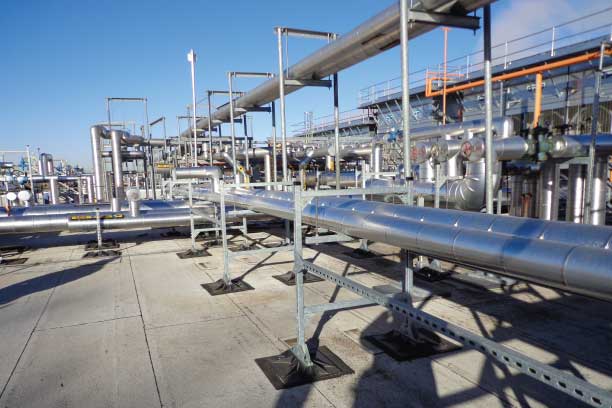
Non-penetrating rooftop pipe supports with polycarbonate bases may be compatible with a particular commercial membrane system when properly specified and accepted by the roofing manufacturer or its authorized representative. Three things matter: base material confirmation for the specific membrane, load distribution within the manufacturer’s allowable limits, and roller supports for long runs where pipe movement creates abrasion against a fixed base. See the rooftop support blocks guide.
Duct supports
Rooftop duct systems can impose substantial loads, particularly for wide, stacked, or heavily insulated ductwork. Rooftop duct supports must be sized accordingly. Confirm the roof assembly’s own load limitations separately. A base adequate for a small duct may not work for a large one.
Mechanical unit supports
Mechanical unit supports can impose significantly higher concentrated loads than many pipe-support applications. Chillers, RTUs, and large condensing units concentrate significant weight into a small footprint. Load calculations for mechanical equipment should confirm contact pressure, point loads, and support spacing against the roofing manufacturer’s requirements and the project’s structural criteria before finalizing specification.
Solar installations
Solar conduit and piping add new systems to rooftops that already carry other loads. The cumulative load from multiple support systems in the same roof zone can exceed allowable limits even when each system individually stays within them. See rooftop solar: how to support conduit and piping without damaging the roof.
Pre-Installation Checklist
Before any rooftop support goes on a warranted commercial roof:
- Identify the roofing manufacturer and membrane type: this determines which requirements apply
- Pull the warranty documentation: review the exclusions for language about materials and penetrations
- Get written confirmation from the roofing manufacturer’s technical team or authorized representative that the base material is compatible with their membrane system
- Calculate support reactions, point loads, and contact pressure, then verify them against the applicable roof-assembly, product, and structural requirements
- Confirm the contractor holds manufacturer approval for any penetrations the support system or adjacent systems require
- Keep all records: manufacturer confirmation, load calculations, base material specifications, installation records