| Quick Answer: On commercial membrane roofs, non-penetrating supports are typically preferred or specified for DC conduit runs, inverter piping, and any associated mechanical lines, helping protect the roof membrane while reducing the risk of warranty issues. The right support depends on how many conduits you’re running, whether they share space with HVAC or gas piping, and whether the roof is in a seismic or high-wind zone. |
Rooftop solar installations get a lot of attention for the panel mounting. Still, the conduit and piping that run from panels to inverters and from inverters to mechanical equipment need just as much planning. On a commercial flat roof, those runs can stretch across the entire building, pass through multiple roof zones, and share space with existing HVAC piping, gas lines, and drainage paths.
Getting the support system right from the start protects the roof membrane, keeps the installation organized, and avoids the kind of rework that happens when conduit runs shift or sag over time. Here’s what to consider for a commercial solar rooftop project.
What needs to be supported on a solar rooftop installation
Most commercial rooftop solar projects involve at least three types of runs that need support:
DC conduit contains the conductors that transmit DC power from the solar array to the inverter. On a large commercial roof, these runs can be long, may involve multiple conduits bundled together, and must be routed around existing equipment and penetrations. This is typically the highest-density conduit run on the roof.
AC conduit runs from the inverter to the building’s electrical system. Usually a single or double conduit run, shorter than the DC side but still needing proper support and clearance off the membrane.
Inverter piping and mechanical lines: most commercial string inverters are air-cooled and do not require rooftop coolant lines. However, some large commercial or utility-scale inverter systems use liquid cooling and add coolant piping to the roof that needs its own support separate from the conduit.
Each of these has different support requirements. DC conduit runs often involve ganging multiple conduits side by side, which calls for a different support type than a single AC conduit run.
Choosing the right support for each run
For DC conduit: strut-based supports
DC conduit runs are typically the most complex part of a solar rooftop support layout. Multiple conduits running in parallel, often at varying heights off the roof, need a support system that can handle all of them cleanly without requiring a separate base for each conduit.
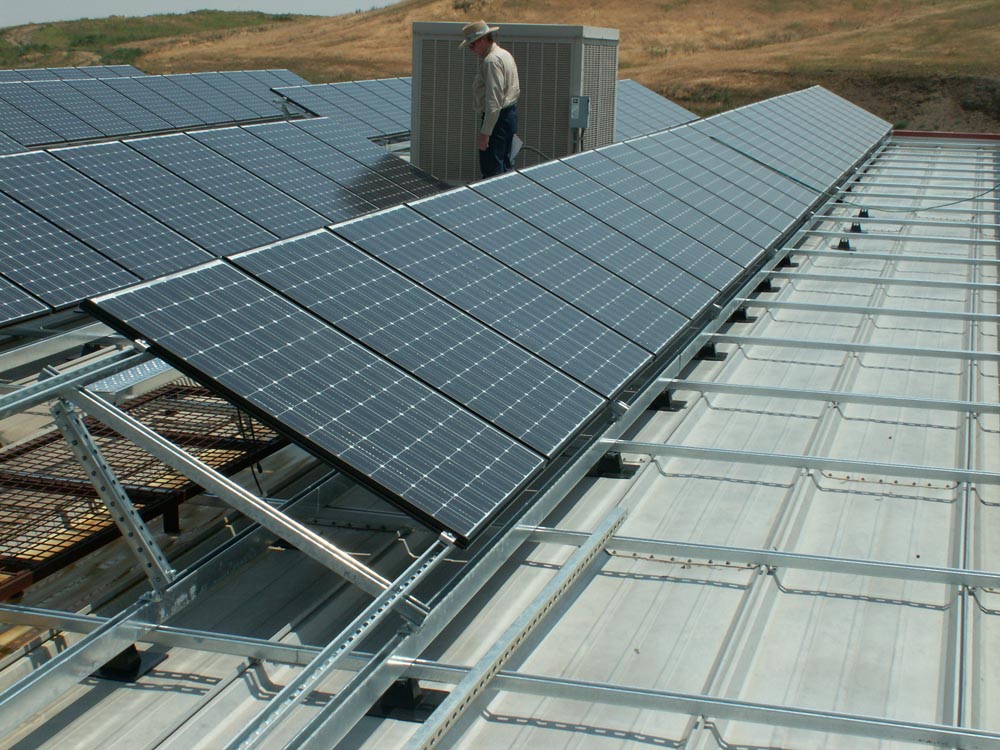
MIRO Industries’ strut-based supports are well suited for these applications. A single strut base can gang multiple conduits together using standard pipe clamps, keeping the run organized and the membrane contact points to a minimum. Base widths from 8″ to 48″ accommodate everything from two conduits to a full DC collection run. Height is adjustable on site to clear existing penetrations, drains, or HVAC equipment in the path.
For the NEC spacing and code requirements that govern conduit runs on commercial rooftops, see the NEC conduit support guide.
For AC conduit and single runs: pillow block or smaller roof supports for conduit
Single or double AC conduit runs from the inverter to the building are straightforward. A standard rooftop pipe support block or a smaller strut base handles these cleanly. The same non-penetrating base design helps protect the membrane and supports warranty compliance.
For inverter piping and coolant lines: roller or fixed pipe supports
Where liquid-cooled inverter systems are used, coolant piping on the roof behaves differently from conduit: it carries fluid, expands and contracts with temperature, and often runs longer distances. For short runs with minimal temperature variation, fixed roof pipe supports work well. For longer runs or systems with significant temperature swings, roller supports allow the pipe to move freely as it expands rather than building up stress at fixed points.
The membrane protection problem unique to solar
Solar arrays change the roof’s thermal profile by shading portions of the membrane. These changing thermal conditions should be considered when designing rooftop support systems, making proper load distribution and membrane protection especially important for solar installations.
Non-penetrating supports with wide base footprints spread load across a larger contact area, protecting the membrane surface without creating penetration points. Where roof penetrations are used, they must be approved and detailed by the roofing manufacturer or an authorized contractor. Unapproved penetrations can void or jeopardize the roof warranty. This is a significant concern for solar projects where building owners have just made a major capital investment.
When seismic or wind zones affect the support layout
Solar installations in seismic or high-wind zones add a requirement that panel mounting alone doesn’t cover: the conduit and piping runs also need to be secured against lateral movement. A well-supported conduit run vertically can still shift laterally in a seismic event if the supports aren’t designed for it.
Projects located in regions with significant seismic or wind design requirements may require engineered restraint systems in accordance with applicable building codes and ASCE 7-22. MIRO Industries’ wind and seismic support systems can be engineered to meet applicable requirements when properly designed for the specific project without creating new penetration points in the membrane. See the ASCE 7-22 seismic/wind guide for more detail.
Coordinating solar support with existing rooftop systems
Commercial rooftops that are getting solar added often already have HVAC piping, gas lines, conduit, and drainage infrastructure in place. Solar conduit and piping need to be routed around or alongside those existing systems without creating conflicts. Clearance from drains, crossover access to equipment, and NEC separation requirements between electrical systems all come into play.
Planning the solar conduit support layout at the same time as the overall roof layout, rather than after the panel mounting is set, avoids the most common conflicts. If the project also involves a cable tray for data or communication lines alongside the solar conduit, see the cable tray guide for how those systems are typically coordinated.
MIRO Industries can do a full support layout for any commercial solar rooftop project: conduit, piping, cable tray, and existing systems. Contact your local MIRO Industries rep or request a quote with the roof plan and solar layout.