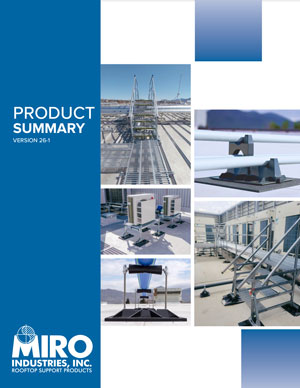
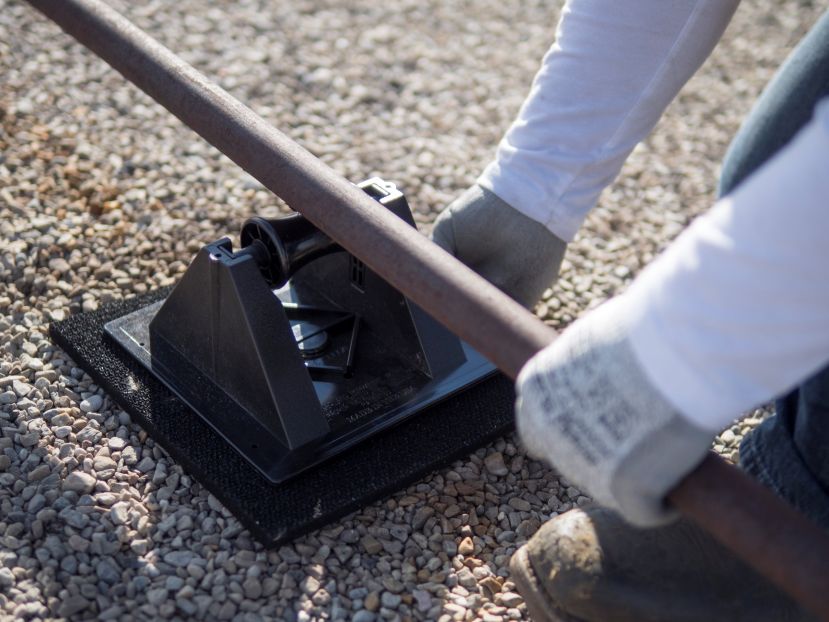
| Rooftop pipe support spacing depends on pipe material, diameter, contents, and load. There is no single universal number. For many commercial applications, MIRO Industries rooftop pipe support blocks are spaced according to manufacturer-published guidance for the specific model and application, with common intervals of 5 to 10 feet depending on the pipe and load conditions. |
On a commercial roof, the support block does a simple but critical job. It carries the load of the pipe or conduit while helping protect the roof surface below. Choose the wrong roof pipe support block, and you can end up with membrane wear, sagging runs, poor drainage clearance, or unnecessary stress on the piping system.
This guide explains what rooftop support blocks are, how to choose between pillow block and roller supports, how to size them correctly, and how to think about spacing without relying on bad rules of thumb.
What is a rooftop support block?
A rooftop support block is a non-penetrating support base that rests on the roof surface and carries the load of pipe, conduit, cable tray, or other rooftop lines. Instead of fastening directly through the membrane, the block spreads weight across a broader footprint to reduce concentrated loading on the roof.
A well-chosen support block should do three things:
- distribute load across the roof surface
- maintain consistent clearance above the roof for drainage, inspection, and maintenance
- stay stable through weather, UV exposure, and temperature changes
For many rooftop applications, non-penetrating supports are preferred because roof penetrations can create weak points in the roofing system and may affect warranty coverage depending on the roof assembly and manufacturer requirements. Always confirm project-specific roofing requirements before installation.
Why rooftop support blocks matter
Support blocks are not just accessories. They affect both rooftop system performance and roof longevity.
The right block can help:
- protect the roof membrane from concentrated loading and abrasion
- keep piping level or properly sloped where needed
- reduce movement-related wear on the pipe and supports
- simplify re-roofing and rerouting compared with penetrating supports
- support a cleaner, more maintainable rooftop layout
The wrong block, or the right block spaced incorrectly, can lead to pipe deflection, support instability, membrane damage, and premature maintenance issues.
Pillow block vs. roller block: which type do you need?
The first question is whether the supported line needs to accommodate longitudinal movement.
Choose a pillow block when:
- the run is short
- the line has little thermal movement
- you are supporting electrical conduit, cable tray, condensate lines, gas lines, or other small mechanical piping
- a simple fixed support is appropriate
Pillow blocks are commonly used for basic rooftop pipe and conduit support because they are straightforward, economical, and easy to install.
Choose a roller block when:
- the pipe expands and contracts significantly with temperature
- the run is long enough for thermal movement to matter
- the line carries hot water, steam, refrigerant, or other fluids with meaningful temperature variation
- the system experiences frequent thermal cycling
Roller supports allow the pipe to move longitudinally with less friction, helping reduce stress on the piping system and roof interface. A roller-supported run should still include at least one fixed anchor point to control movement and prevent the pipe from drifting over time.
How do you size a rooftop support block?
Sizing roof blocks for pipe comes down to matching the support to the application. Focus on these factors:
Load
Start with the total supported load, not just the empty pipe. Include:
- pipe weight
- fluid weight
- Insulation
- cable tray fill, if applicable
- any additional supported components
Heavier loads typically require larger or higher-capacity supports and wider load distribution.
Clearance height
Determine how high the line needs to sit above the roof. Clearance may be driven by:
- drainage needs
- insulation thickness
- maintenance access
- coordination with other rooftop equipment
- code or project specifications
Some supports provide a fixed clearance, while others allow height adjustment or the use of spacers and accessories.
Pipe or conduit size
The saddle, cradle, or roller assembly must fit the supported line correctly. Fixed supports and roller supports are both application-specific, so pipe diameter and outside diameter matter.
Roof protection requirements
In some applications, a support pad or accessory may be recommended to provide additional protection for the membrane. Check the manufacturer’s documentation for the exact support assembly, not just the base unit.
How far apart should rooftop support blocks be spaced?
There is no single universal spacing number for rooftop support blocks.
Proper spacing depends on factors such as:
- pipe material
- pipe diameter
- supported contents
- total load
- pipe stiffness
- thermal movement
- wind exposure
- project-specific code or engineering requirements
That is why spacing should be based on manufacturer recommendations and project engineering, not guesswork. As one example, MIRO’s Model 1.5 page lists recommended spacing not to exceed 7-foot centers depending on load, which illustrates why spacing must be tied to the exact support model and application rather than copied from a generic rule.
In practice, larger and stiffer pipe may span farther, while smaller, more flexible, or more heavily loaded lines often need closer support spacing.
Common rooftop support block mistakes
Using one spacing rule for every pipe
Different materials, diameters, and loads behave differently. Treating every run the same is a common source of sagging and overstressed supports.
Choosing fixed supports for lines with thermal movement
If the pipe is expected to expand and contract significantly, fixed supports alone may create unnecessary stress.
Ignoring clearance needs
A support that is too low can interfere with drainage, inspection, reroofing, or insulation requirements.
Focusing only on initial cost
Low-cost improvised supports may seem attractive upfront but can create higher maintenance and replacement costs later.
Skipping manufacturer documentation
Support selection should always be based on current product literature, spacing guidance, and project conditions.
Support blocks vs. wood blocks
Wood blocks were once a common field solution for supporting rooftop piping, but they come with well-known drawbacks. Over time, wood can weather, rot, shift, and deteriorate. It can also increase the risk of uneven support and roof-surface wear if used improperly.
Engineered rooftop support blocks are designed to address those issues with more consistent geometry, better material performance, and a more predictable load path. For many projects, they are the more durable and maintainable choice.
How to specify rooftop support blocks in four steps
- Identify what is being supported: Document the type of line, its size, and what it carries.
- Calculate the supported load: Include the line itself, contents, insulation, and any attached components.
- Decide whether the line needs fixed or moving support: Use fixed pillow blocks where thermal movement is minimal. Use roller supports where longitudinal movement needs to be accommodated.
- Set clearance and spacing based on the current manufacturer data: Choose the required height, add pads or accessories as needed, and use the manufacturer’s current spacing guidance for the exact support and application.
Specifying rooftop support blocks for a project? MIRO Industries makes a full line of non-penetrating pillow block and roller support blocks, from light conduit runs to heavy-duty applications. Request a quote or find your MIRO rep for help matching the right block to your load, height, and spacing.
Frequently Asked Questions
Rooftop support blocks may be small components, but they have a big impact on roof performance and piping reliability. The right support type, correct sizing, and proper spacing all matter. Start with the actual load and movement requirements, then match the support to the application using current manufacturer data.
If you are specifying rooftop pipe supports for a project, use current product literature and spacing guidance for the exact support model you plan to install. That is the best way to protect both the piping system and the roof beneath it.