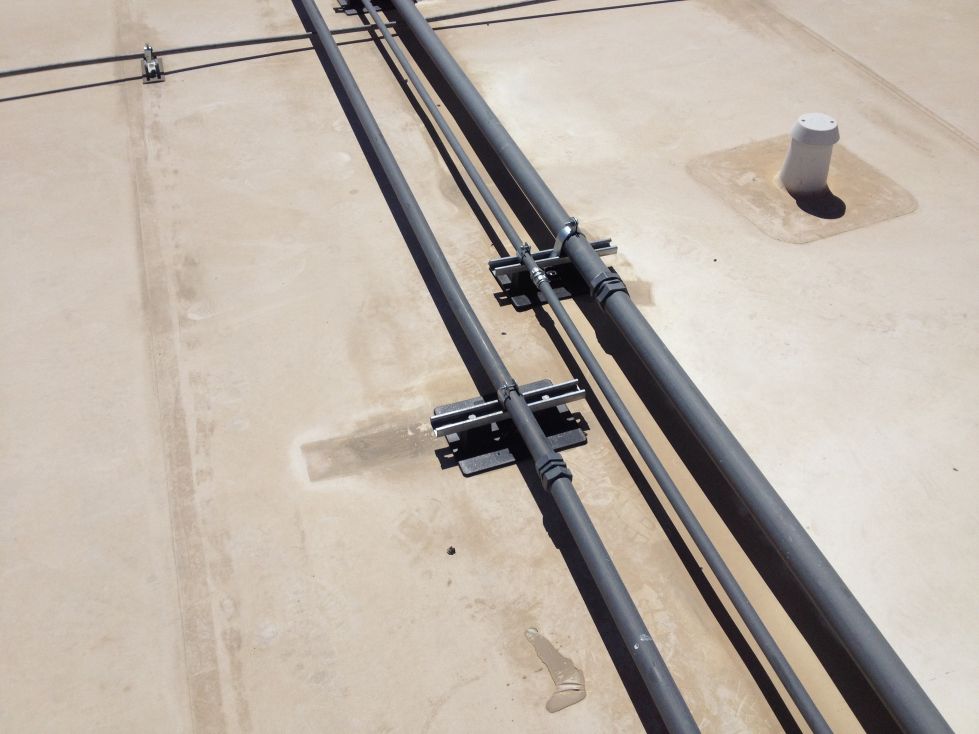
NEC Articles 344.30, 352.30, and 358.30 govern support spacing for rooftop conduit. Most metal raceways (RMC, IMC, EMT) require supports at intervals not exceeding 10 feet, with a support within 3 feet of every box or fitting; rigid PVC spacing varies by trade size under NEC Table 352.30. MIRO Industries manufactures non-penetrating rooftop conduit supports, including pillow block, strut-based, and adjustable-height configurations, that satisfy NEC spacing and clearance requirements for commercial flat-roof installations.
Already know why engineered conduit roof supports beat wood blocks and bricks? Good. Our contractor’s guide to conduit roof supports covers that ground. This guide picks up where it leaves off, the NEC code requirements that govern rooftop conduit installations, how to space and height-set supports correctly, and a step-by-step installation sequence.
Addressing these requirements correctly results in a system that passes inspection, protects the roof warranty, and performs reliably for the life of the building. Overlooking them tends to surface later during re-inspection, on a warranty claim, or as an ampacity issue on a high-demand summer day.
NEC Requirements for Rooftop Conduit Supports
How far apart do rooftop conduit supports need to be?
Support spacing for metal raceways and PVC raceways is governed by NEC Articles 344.30 (RMC), 352.30 (PVC), and 358.30 (EMT). The maximum intervals are:
| Conduit Type | Max Support Spacing |
| RMC / IMC / EMT | Up to 10 feet (verify by raceway type and size) |
| Rigid PVC (Schedule 40 or 80) | Varies by trade size (often 3 ft for smaller sizes; wider intervals for larger according to NEC Table 352.30) |
| FMC / LFMC | 4.5 feet for FMC (NEC 348.30); 3 to 4.5 feet for LFMC, depending on trade size (NEC 350.30) |
| All types — near terminations | Within 3 feet of any outlet box or fitting |
NEC rule: All conduit types require a support within 3 feet of every outlet box, junction box, or fitting, regardless of the interval for the rest of the run. (NEC 344.30, 352.30, 358.30) Exception: NEC 352.30(A) permits the first support to be up to 5 feet from a box or termination for rigid PVC in trade sizes 2 inches through 6 inches.
These are code minimums, subject to NEC article-specific exceptions and fastening requirements. Tighter spacing may be required based on conduit diameter, load, or wind exposure category. Confirm with the project engineer for runs subject to high wind or heavy conduit bundles.
Source: NEC Articles 344.30, 352.30, 358.30: “Rigid Metal Conduit: Type RMC,” “Rigid Polyvinyl Chloride Conduit: Type PVC,” “Electrical Metallic Tubing: Type EMT.” National Fire Protection Association. nfpa.org. Summarized by Steel Tube Institute.
How high above the roof does conduit need to be?
The NEC rooftop sunlight temperature adjustment provisions apply a 33°C (60°F) temperature adder to the local outdoor ambient temperature when calculating conductor ampacity, unless the conduit is installed with its bottom edge at least 7/8 inch above the roof surface. The specific threshold has evolved: 7/8 inch in the 2017 and 2020 NEC, revised to 3/4 inch in the 2023 NEC. At or above the applicable threshold, the adder does not apply. Below it, it does. Always verify which NEC edition is adopted by the local jurisdiction. (Referenced as NEC 310.15(B)(2) in recent editions; section numbering varies by edition.)
Source: NEC rooftop sunlight temperature adjustment provisions (historically NEC 310.15(B)(2); numbering varies by edition). National Fire Protection Association. nfpa.org. See also: “Under the Hot Sun: Ambient Temperature Adjustments on Rooftops,” Electrical Contractor Magazine, October 15, 2016.
This adder has a significant practical effect on wire sizing. For example, in a 110°F rooftop ambient condition, the NEC rooftop sunlight temperature adjustment provisions add 60°F when applying conductor ampacity correction factors. That elevated effective ambient can substantially reduce the allowable ampacity and may require larger conductors, depending on the insulation type and terminal ratings.
Source: “Stumped by the Code? NEC Requirements for Ambient Temperature Correction to Conductor Ampacity.” EC&M, September 23, 2021.
Standard 1-5/8″ strut channel, the type used in most strut-based roof supports for conduit, can meet the 7/8″ clearance threshold in many common assemblies; the finished installed height should always be verified. The rooftop clearance threshold has evolved across NEC editions: earlier editions used a distance-based table; the 2017 NEC simplified this to a single 7/8″ threshold; and the 2023 NEC further revised it to 3/4″. The threshold conveniently aligns with standard 1-5/8″ strut dimensions commonly used in rooftop support systems. Always verify which NEC edition is adopted by the local jurisdiction.
Source: NEC rooftop sunlight temperature adjustment provisions and 7/8″ threshold: “310.15(B)(2) Rooftop.” ElectricalLicenseRenewal.com.
What does the NEC require for thermal expansion of rooftop conduit?
Thermal expansion and contraction should be considered for rooftop conduit exposed to significant temperature swings, particularly for PVC raceways governed by NEC 352.44. On sun-exposed rooftops, this matters most for:
Rigid PVC conduit (NEC 352.44): PVC expands and contracts at a much higher rate than metal conduit. An expansion fitting is required wherever a straight run is expected to move 1/4 inch or more due to thermal cycling. Long south-facing runs often reach this threshold.
RMC and IMC: Metal conduit has lower thermal expansion than PVC, but may require consideration for thermal movement on long exposed runs, depending on installation conditions and manufacturer guidance.
Source: NEC 352.44, “Expansion Fittings.” National Fire Protection Association. nfpa.org. See also: “NEC PVC Conduit Rules: Article 352 Support & Burial Charts.” Ledes, December 7, 2023.
How conduit is clamped to the conduit roof supports affects expansion compliance. Intermediate support points on PVC runs should use saddle-style clamps that allow longitudinal movement; rigid clamping at every point forces thermal stress into fittings rather than the expansion fitting where it belongs.
Do local codes add requirements beyond the NEC for rooftop conduit?
Yes. The NEC is a minimum standard, and many jurisdictions impose additional rooftop access requirements on top of it. Some jurisdictions require crossover steps, ramps, or platforms to preserve rooftop access routes for emergency responders, typically once conduit groupings exceed specified height or width thresholds. New York City Fire Code Section 504.4.7 is one example of such a local requirement; thresholds and applicability vary significantly by jurisdiction and fire code adoption. Always verify with the Authority Having Jurisdiction (AHJ) before finalizing the conduit layout.
Source: New York City Fire Code 2022, Section 504.4.7, “Rooftop Conduits and Piping.” UpCodes.
Choosing the Right Support for Your Conduit Type
From a code-compliance standpoint, the selection decision comes down to two questions: does the support clear the applicable NEC rooftop clearance threshold above the deck (3/4″ under 2023 NEC; 7/8″ under 2017/2020 NEC), and does it allow thermal movement for PVC runs?
Pillow block supports work for single-conduit runs where a low profile is acceptable, and the conduit type is metal (RMC, IMC, EMT). Verify the block height meets the 7/8″ clearance requirement before specifying.
Strut-based roof blocks for conduit are the default choice for multi-conduit runs, PVC conduit of any diameter, and any run where height above the deck must be confirmed or adjusted on-site. The 1-5/8″ strut height typically provides sufficient clearance to satisfy the 7/8″ threshold when installed with standard channel and clamp configurations; field verification is still recommended. Standard saddle clamps allow PVC to move longitudinally.
Adjustable-height supports are used where the roof surface is uneven or where conduit must clear equipment at varying heights, both of which make it difficult to pre-specify a fixed-height block.
For projects in high-wind or seismic zones, rooftop conduit supports may need to meet ASCE 7-22 non-structural component requirements, including bracing or ballast calculations. See How to Meet Seismic and Wind Load Requirements Without Voiding Your Rooftop Warranty for a full breakdown.
How to Install Rooftop Conduit Supports: Step by Step
The following sequence covers a standard commercial flat-roof conduit run using strut-based electrical conduit roof supports.
- Plan the route. Mark penetration points, identify HVAC equipment, drains, or skylights in the path, and determine expansion fitting locations before starting on the roof.
- Mark support locations. Use the NEC spacing for your conduit type, 10 feet for RMC/IMC/EMT, and per NEC Table 352.30 for PVC (varies by trade size; 3 feet for many smaller sizes), and mark within 3 feet of every box and fitting. (NEC 344.30, 352.30, 358.30)
- Verify support height. Confirm the selected support will place the bottom of the conduit above the applicable clearance threshold, 3/4″ under the 2023 NEC, 7/8″ under the 2017/2020 NEC, before ordering material. Standard 1-5/8″ strut-based supports typically provide sufficient clearance when installed with compatible channel and clamp configurations, but field verification is still recommended.
- Place bases on the membrane. Follow the support manufacturer’s installation instructions and the membrane manufacturer requirements. Many non-penetrating support systems are designed to avoid direct roof penetrations under standard conditions, though securement methods vary by manufacturer, wind exposure, and project requirements.
- Attach conduit with the appropriate clamp. For PVC, use saddle-style clamps at intermediate supports to allow longitudinal movement. Fasten rigidly only at terminal ends and at expansion fittings. For metal conduit, use clamps or straps approved for the raceway type and compatible with the support system manufacturer’s requirements.
- Install expansion fittings where required. For PVC raceways, calculate expected movement using the conduit manufacturer’s thermal expansion coefficient and the project’s expected temperature range. NEC 352.44 requires an expansion fitting wherever anticipated movement equals or exceeds 1/4 inch.
- Add crossovers if required by local code. Some jurisdictions impose crossover or access-path requirements once rooftop conduit groupings exceed specified dimensions; thresholds vary by jurisdiction and fire code adoption. Confirm requirements with the AHJ.
- Inspect the completed run. Verify: every support is stable and level; no conduit contacts the membrane between supports; no fitting is under mechanical stress; the applicable clearance threshold is maintained along the full run (3/4″ under the 2023 NEC; 7/8″ under the 2017/2020 NEC).
Common Code Compliance Mistakes on Rooftop Conduit Runs
Using 10-foot spacing for PVC conduit: PVC conduit support spacing varies by trade size under NEC Table 352.30. Smaller trade sizes are commonly limited to 3-foot intervals, while larger sizes permit wider spacing. Assuming EMT’s interval applies to all PVC sizes is a common inspection issue on rooftop conduit work.
Rigid clamping on PVC at every support: Prevents the expansion fitting from absorbing thermal movement; stress transfers to couplings and fittings instead.
Installing conduit below the applicable clearance threshold (3/4” under the 2023 NEC; 7/8” under the 2017/2020 NEC): Triggers the NEC rooftop sunlight temperature adjustment provisions and may require conductor upsizing. Easily avoided with the right support height.
Not sizing conductors for the rooftop temperature adder: If the 7/8″ threshold wasn’t met at design, conductors may be operating near their allowable ampacity limits under corrected ambient temperature.
Skipping the AHJ check: Many jurisdictions require crossovers, clearance from access routes, and other items that the NEC alone does not cover.
Design a Code-Compliant, Warranty-Safe Rooftop Conduit Support System
MIRO Industries offers a complete line of rooftop conduit supports, pipe supports, duct supports, and wind and seismic engineered support systems, all backed by a 20-year warranty and made in the U.S.A. Send us a message or request a quote to discuss your project requirements.
| Disclaimer: This article is provided for general informational purposes only and is not a substitute for project-specific engineering analysis, manufacturer recommendations, or local code review. Always consult a licensed professional engineer and the applicable Authority Having Jurisdiction (AHJ) before finalizing any rooftop conduit support design. |
Frequently Asked Questions
Source: NEC Articles 344.30, 352.30, 358.30. National Fire Protection Association. nfpa.org.
Source: NEC rooftop sunlight temperature adjustment provisions. National Fire Protection Association. nfpa.org.
Source: NEC 352.44, “Expansion Fittings.” National Fire Protection Association. nfpa.org.
Source: NEC rooftop sunlight temperature adjustment provisions. National Fire Protection Association. nfpa.org. See also: “NEC 310.15 Ampacity Derating: Temperature × Conduit Fill Factor Tables.” EleCalculator.