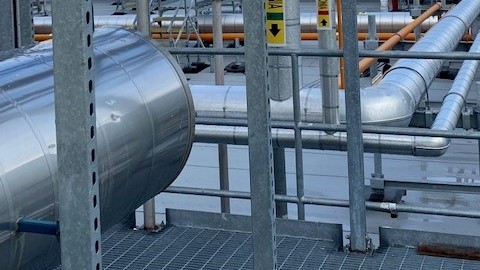
When ductwork runs across or out from a rooftop platform, most contractors assume the platform handles the support — and that assumption causes problems. The platform structure and the roof duct supports are two separate systems with separate load paths, separate base requirements, and in some cases, separate compliance requirements.
Getting the specification right before you order saves rework, protects the roof membrane, and keeps the installation compliant with your roofing manufacturer’s warranty. Below are the six decisions you need to make — in order — when duct supports are part of a rooftop platform system.
Decision 1: Is the Duct Support Load-Bearing or Lateral Only?
This is the first question to answer because it determines the entire support family you’re working with.
Load-bearing duct supports carry the vertical weight of the duct itself — the weight of the duct material, any insulation wrapped around it, and, in some cases, the weight of air or product moving through it. These are the supports you need when the duct is running horizontally along or above the platform surface with no other structure beneath it.
Lateral-only supports work when the duct is already resting on something else — a curb, a mechanical unit, or part of the platform frame itself — and you just need to prevent it from shifting side to side under wind or vibration. These are less common in standalone rooftop duct runs but come up frequently when ductwork exits an RTU and transitions onto an adjacent platform.
Quick Rule: If the duct has nothing beneath it and is held up only by the support, it is load-bearing. If the duct rests on a surface and the support only prevents lateral movement, it is lateral-only.
MIRO engineers its custom duct supports and custom hanger supports for load-bearing applications. Use hanger supports where the duct needs to be suspended from above rather than supported from below.
Decision 2: What Is Your Duct Size and Shape — and Does It Change Along the Run?
Duct size and cross-section directly determine support selection. A support sized for 8-inch round ductwork will not correctly cradle a 12-inch rectangular duct, and a support designed for rectangular duct will not grip a round spiral duct without modifications.
The three variables that determine which support model you need:
- Shape: round/spiral vs. rectangular/flat-oval
- Size: width or diameter at each support location
- Transition points: where the duct changes shape or size along the run
Mixed runs — where a round duct transitions to rectangular, or where duct size steps down as the run extends — require varying support models at multiple points along the same run. This is one of the most common specification errors: ordering one support model for the whole run when the duct geometry changes halfway across the platform.
MIRO’s 6-DS, 8-DS, and 10-DS custom rooftop duct supports cover the most common commercial duct sizes. If your duct run includes unusual dimensions or transitions, request a custom layout — MIRO’s team can provide a support-by-support specification based on your duct drawings.
Decision 3: What Is the Height Clearance Between the Roof Surface and the Bottom of the Duct?
Clearance height determines which MIRO duct support model applies to your project. This is a physical measurement you need before selecting a model — and it has to come from your drawings or a site measurement, not a guess.
MIRO publishes the minimum and maximum clearance ranges for each DS model. Here is what those specs look like in practice, based on MIRO’s published 6-DS, 8-DS, and 10-DS specifications:
| Model | Min. Clearance | Max. Clearance | Base Size |
| 6-DS | 12 inches | Typically 36 inches | 9″ x 15.25″ |
| 8-DS | 14 inches | Project-specific | 16″ x 18″ |
| 10-DS | 14 inches | Project-specific | 19″ x 23″ |
All three DS models feature vertical adjustability — the corner bracket channel nuts let you adjust the horizontal support strut up and down during installation, giving you the flexibility to fine-tune height on an uneven platform surface. Maximum loading from any MIRO base to the finished roof surface is not to exceed 3.0 psi unless specifically allowed otherwise in project specifications.
Decision 4: Does the Platform Location Require Wind or Seismic Compliance?
This is a yes/no check, and it should happen before you finalize any support selection — not after. Two questions determine whether you need engineered wind and seismic documentation:
- Is the project located in a high-wind zone (coastal areas, open plains, or locations subject to local jurisdiction wind requirements)?
- Is the project in a seismic zone where code requires positive attachment of rooftop equipment?
If the answer to either is yes, positively attach the duct support system to the structure — don’t just ballast or friction-set it — and get engineering documentation to back it up. Standard non-engineered supports are not sufficient for these conditions.
Important: Non-penetrating does not mean non-anchored. Code-compliant wind and seismic pipe supports must be positively attached to the structure. However, roof penetrations are often not needed at every support location. MIRO's team can engineer a compliant layout that limits roof penetrations while still meeting attachment requirements.
MIRO provides wind and seismic-engineered rooftop support systems with stamped calculations. Review the Wind and Seismic product page for an overview of what is available, and request a quote with your site location and duct load information so the team can confirm compliance requirements.
Decision 5: Will Maintenance Workers Need to Access the Duct from the Platform?
Ductwork on a rooftop platform isn’t just a mechanical element — it’s also a physical obstacle for anyone who needs to service the equipment nearby. If maintenance workers will regularly walk the platform to access an RTU, air handler, or disconnect panel, duct support placement has to account for that foot traffic.
Three scenarios to identify:
- Duct runs parallel to the maintenance path: Adjust support spacing to leave clear walking lanes between supports. Standard spacing optimized for pipe load may put supports exactly where a technician needs to step.
- Duct runs perpendicular to the maintenance path: Add a crossover to allow workers to pass over the duct safely without stepping on it. Regularly stepping on a duct will eventually cause it to fail at the connection points.
- Duct is at head height or above: Confirm clearance for workers walking beneath the duct run — OSHA general industry standards require a minimum walking height clearance for regularly accessed work areas.
If crossovers are part of the solution, MIRO’s crossovers, ramps, and platforms can be integrated into the overall system layout. The rooftop walkway systems guide covers the key considerations for designing safe access around rooftop equipment — including how duct runs affect walkway routing.
Decision 6: What Is Your Roof Membrane Type?
Duct support bases sit directly on the roof membrane, and the wrong base material or installation method can void your roofing manufacturer’s warranty — regardless of how well the duct support itself is specified. This decision is about base compatibility, not structural capacity.
MIRO’s duct support bases are compatible with various roofing membranes. Polycarbonate is the standard base material across the 6-DS, 8-DS, and 10-DS product lines; stainless steel bases are also available. Maximum loading from any MIRO base to the finished roof surface is not to exceed 3.0 psi — this load distribution limit is what protects the membrane from point-load damage, regardless of membrane type.
Most important step: confirm base compatibility with your roofing manufacturer before installation for any membrane type. Most commercial roofing warranties have specific language about what can be placed on the membrane and how. Installing supports without confirmation voids the warranty; the contractor—not the manufacturer—assumes liability.
Never place bare metal, wood, or improvised materials directly on any roof membrane. For a detailed breakdown of what goes wrong when supports are installed incorrectly, see the Costly Mistakes to Avoid When Installing Rooftop Pipe Supports post — it covers the specific failure modes that lead to membrane damage and warranty voidance.
All Six Decisions at a Glance
Use this as a pre-order checklist before submitting your specification or quote request.
| Decision | Key Question | Where to Look |
| Load type | Load-bearing or lateral? | Duct Supports page |
| Duct size & shape | Round, rect, mixed? | 6-DS / 8-DS / 10-DS guide |
| Height clearance | How much space is under the duct? | 6-DS / 8-DS / 10-DS guide |
| Wind/seismic | High-wind or seismic zone? | Wind & Seismic page |
| Maintenance access | Workers walking near duct? | Walkway & Crossover page |
| Roof membrane | TPO, EPDM, metal, modified bitumen? | Costly Mistakes post |
Get a Specification for Your Project
MIRO Industries reviews duct and platform layouts, delivering support-by-support specs including base selection, spacing, and wind/seismic documentation. All MIRO duct supports are made in the USA and backed by a 20-year warranty.
To get started, visit the MIRO Quote Request page or reach out to a Rep Near You.